This summer, when I joined the Rising Wildlife Leaders in Manaus as a Moore Foundation representative, I expected to meet talented young conservationists. The program led by Wildlife Conservation Network brings together young professionals from across Amazonia for two years of training, mentorship and community-building. Its aim is simple and ambitious: prepare the next generation of leaders who will guide conservation across the Amazon for decades to come.
What I did not expect was the overwhelming sense of responsibility these conservation fellows carried. They walked into the room with enthusiasm, but also with a deep awareness of the environmental pressures facing their communities — from shifting seasonal patterns to increasing pressures on local territories. Their words were both grounding and inspiring. In them, I saw a generation ready to step into leadership, prepared not only to respond to immediate threats, but also to imagine a future where the Amazon thrives.
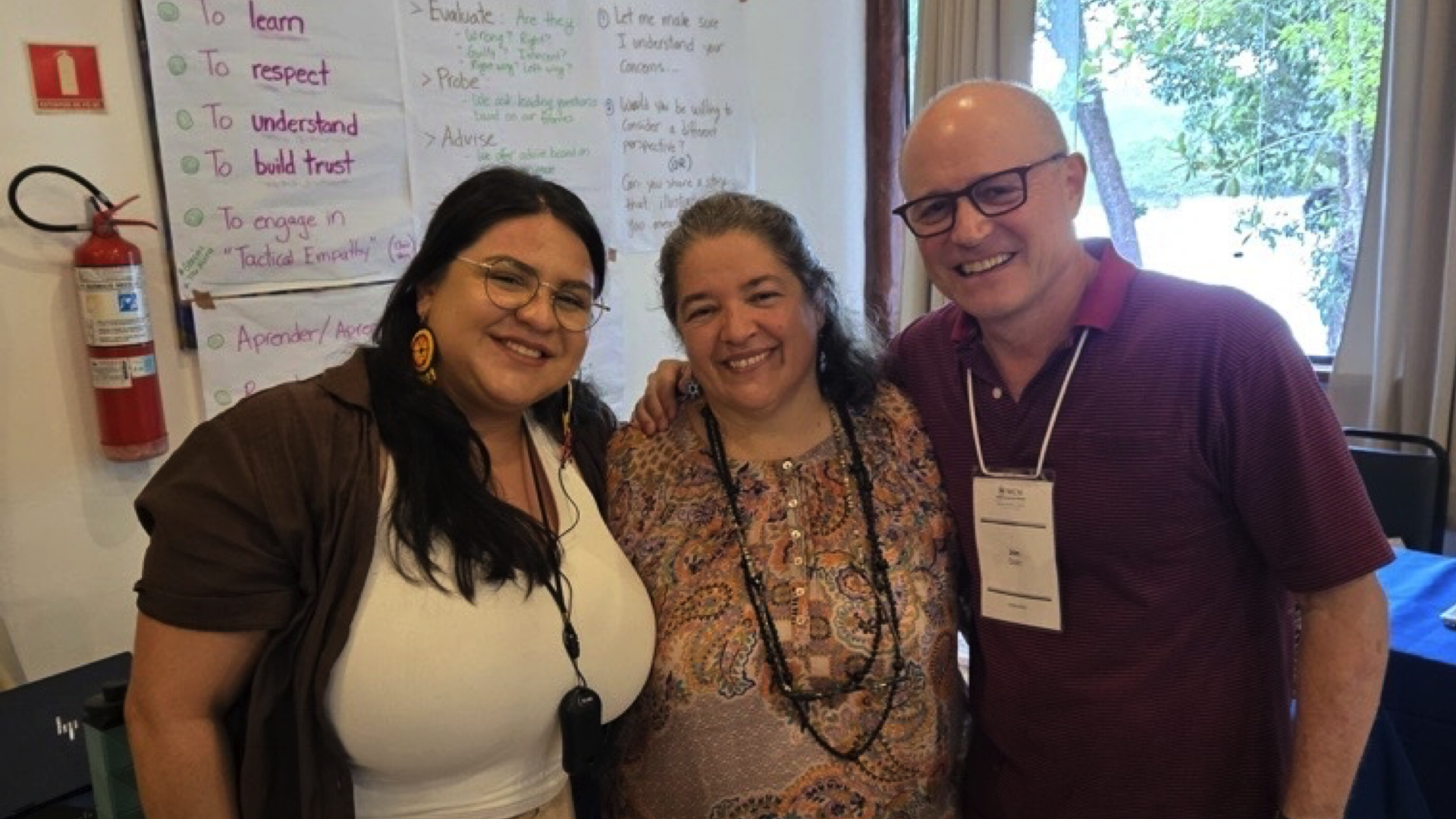
Left to right: participant Adilene Jezabel Moreno, instructor and mentor Tita Alvira, and instructor Jonathan Dain.
My own path to conservation began much closer to home. I grew up in Gilroy, an agricultural town defined by open fields, generational farming and steady development pressure. As the youngest planning commissioner in my city, I often found myself navigating the tension between supporting necessary growth and protecting the landscapes that sustain our community’s identity. Early on, I grappled with moments of self-doubt in rooms filled with more senior voices, yet my commitment to the future of my hometown and the land that shaped me never wavered. Those experiences exposed me to the realities of expansion, land-use conflicts and the complex question of how to safeguard what communities value as they evolve. Sitting with the conservation fellows in Manaus, I recognized that same sense of responsibility. Their efforts to protect ecosystems and strengthen local governance echoed the very questions I have wrestled with in my own community, just scaled across a biome of global importance.
The Rising Wildlife Leaders program provides two years of mentorship, peer connection and financial support. Two years is a short window in the lifespan of conservation, where work is measured in decades. We often track outcomes in terms of hectares of forest under protection, a vital measure of success. But being in Manaus reminded me that hectares endure only when there are people and systems in place to defend them. Behind every forest preserved today, there are leaders ensuring it remains protected tomorrow.
This perspective on environmental conservation is deeply aligned with the intent Gordon and Betty Moore set for the foundation, including creating enduring differences, pursuing significant impact and taking on challenges that require long-term commitment. Some results can be tallied within a grant cycle; others unfold more slowly, through the people whose efforts continue long after a project concludes.
Conservation work often confronts the paradox of urgency and patience. The threats facing the Amazon are immediate — fires, illegal land grabs, infrastructure expansion without safeguards. Yet the solutions that endure are rarely quick. They are built through strong institutions, resilient communities and leaders who can adapt as conditions change.

Carmem Prado Godinho, known by her Indigenous name Racü, meaning “a bird that enchants,” gives a tour of the trail through the Brazilian Amazon created by her Tatuyo community.
Throughout history, societies have depended on such leadership to safeguard their most vital resources. Policies, monitoring systems and technology matter, but it is committed local leaders who turn those tools into real protection on the ground. The Amazon is no different. Protecting the biome requires more than boundary lines on a map; it requires a generation prepared to defend its ecological and cultural value over the long term.
These conservation fellows becoming leaders I met in Manaus left me convinced that this hope in the future of Amazon conservation and its leadership is well-founded. Their vision reached beyond their own towns and regions. They spoke of the Amazon as a shared responsibility and of their role in creating pathways for others to follow. The measurable outcomes of this program may be difficult to capture in just two years, but the seeds planted will continue to grow — in new policies shaped, in communities mobilized and in future leaders inspired by their example.
In my time at the foundation, I have come to appreciate our founders’ belief that the most meaningful outcomes are those that benefit future generations. In Manaus, I saw that aspiration reflected clearly. Together, we represent not only the promise of the present, but the durability of conservation’s future.
When I returned home to my agricultural town of Gilroy, I carried with me the same inspiration I saw in my Amazonian peers’ eyes — a reminder that protecting the places we love is not only about the land itself but also about the people who commit themselves to its care. The future of conservation lives in those who will inherit these landscapes.
Adilene Jezabel Moreno supports the management of the grants portfolio and operations budget for the Andes-Amazon Initiative.

Message sent
Thank you for sharing.